Butrint
A UNESCO archaeological park where Greek, Roman, Byzantine and Venetian ruins sit in a quiet lagoon of forest and water.
Highlights
Sights
A short itinerary
- Day 1· Arrive, check in, wander and get your bearings
· First look: Roman theatre - Day 2· Roman theatre
Good to know
- Go early or late to avoid tour groups
- Easy half-day trip from Ksamil or Sarandë
- Combine with a Ksamil beach afternoon
Where to stay
Butrint is an archaeological park inside a national park, not a town. There is nowhere to stay on site, so you visit from somewhere nearby.
- Sarandë — Twenty minutes away, with the most restaurants and the ferry to Corfu. The usual base.
- Ksamil — Fifteen minutes away, and the better choice if you want the beach in the afternoon.
- Further afield — Gjirokastër is about an hour and a half, which makes Butrint a long but possible day trip.
What to see
What makes Butrint unusual is not any single monument but the fact that Greek, Roman, Byzantine, Venetian and Ottoman layers all sit on the same small wooded hill above a lagoon.
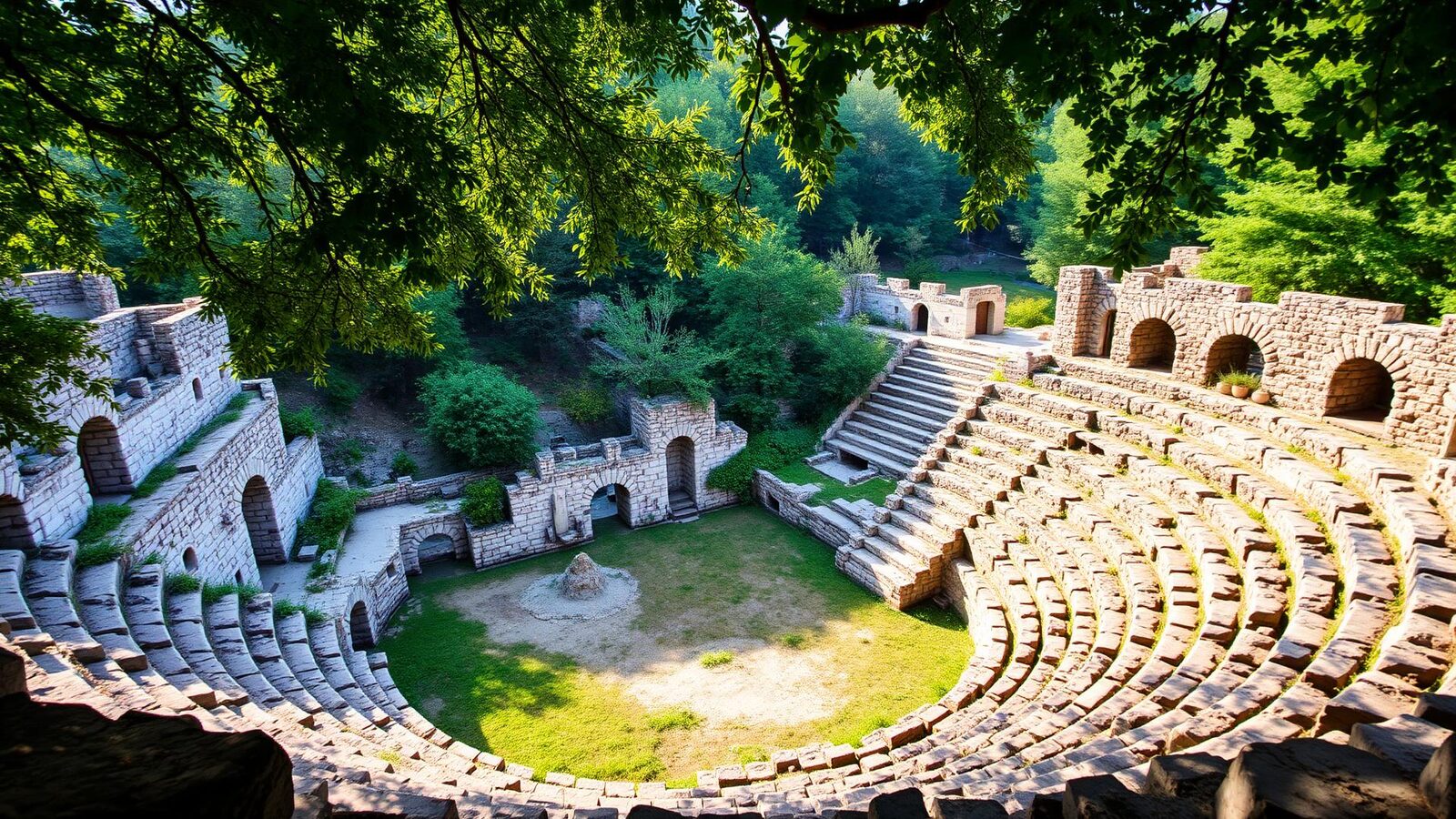
- The theatre — Greek in origin, Roman in its surviving form, and often standing in shallow water.
- The baptistery — Sixth century, with one of the largest early Christian mosaic floors in the Mediterranean. It is usually kept under a protective layer of sand, so check before you build your visit around it.
- The Lion Gate — A monumental block carved with a lion killing a bull, reused in the walls.
- The Venetian tower and castle — On the top of the hill, with a small museum and the view over the whole lagoon.
- The Vivari channel — Crossed by a cable ferry, with the triangular Ali Pasha fortress on the far side.
Getting there
- From Sarandë — Twenty minutes by car. A municipal bus runs several times a day in summer.
- From Ksamil — Fifteen minutes.
- By boat — Some operators run trips from Sarandë along the coast and up the channel, which is a pleasant if slower way in.
How long to stay
- Two to three hours — Enough to walk the full circuit at a reasonable pace.
- Half a day — Better, with time for the museum and the lagoon.
- A full day — Only if you combine it with Ali Pasha's fortress and the lagoon beaches.
Worth knowing before you go
- Go first thing or late afternoon. The coach groups arrive in the middle of the day and the site is small.
- There is shade among the trees but the open sections are unrelenting in July and August. Take water.
- The baptistery mosaics are usually covered with sand to protect them and are only uncovered occasionally.
- The site is on boardwalks and gravel paths, with some steep sections up to the castle.
Combine with
Getting there, and the bus that catches people out
Butrint sits about eighteen kilometres south of Sarandë and five south of Ksamil, at the end of the coast road.
- The bus — a regular service runs from near the ferry terminal in Sarandë, through Ksamil, to the park gates. A couple of hundred lek, roughly forty minutes from Sarandë or fifteen from Ksamil, every half hour in summer and hourly out of season. Pay the conductor in cash on board.
- The detail worth noting — the last bus back tends to leave around five in the afternoon. Confirm the time with your driver on the way out, because the site stays open later than the bus runs.
- Taxi — roughly two to two and a half thousand lek one way from Sarandë. Agree the fare first, and agree separately whether the driver waits.
- Driving — free parking at the gate, though it fills in summer. There is overflow across the Vivari Channel reached by a small car ferry.
What you will actually see
Butrint is Albania's first UNESCO site and the most complete ancient city in the country: a Greek sanctuary, a Roman theatre, an early Christian baptistery, a Byzantine basilica, a Venetian tower and an Ottoman castle, all on one wooded peninsula between a lagoon and a channel.
- The theatre — third century BC, cut into the hillside, seating around two and a half thousand. Still used for performances in summer.
- The Lion Gate — a Hellenistic gateway with a carved lion, among the oldest carved stone in Albania.
- The Great Basilica and the baths — the basilica is the most photogenic ruin on the site, and the Roman baths still show their underfloor heating.
- The acropolis museum — at the top, worth the climb, and on shorter hours than the park itself.
One thing to know before you come. The sixth-century baptistery mosaic is the image on most of the brochures, and it is normally buried under a protective layer of sand and gravel. It is uncovered only briefly, every few years. Knowing that in advance means you can enjoy everything else rather than spending the visit looking for it.
Timing, and Ali Pasha's castle
The park opens at eight and runs to sunset. It gets hot and busy from about eleven, and there is very little shade on the trail, so the early bus is the one to take. Late afternoon works just as well and gives you the better light on the water.
Allow an hour and a half to two hours for the main circuit, or two to three with the museum and a slower pace. The paths are uneven stone, fine in decent shoes but not passable with a pushchair.
Most visitors stop at the main ruins and miss the best short add-on. From near the entrance, local boatmen run across the Vivari Channel to Ali Pasha's castle, a triangular fortress on its own island at the mouth of the channel, for a few euros. Twenty minutes there, and almost nobody else on it.
Bring water, a hat and cash, since cards are not reliably accepted.
Before you go
Plan your trip to Butrint
Book the essentials at the best prices. Some links are affiliate links — we may earn a commission at no extra cost to you.